Upgraded magnetic concentration technology realizes 0.1mm micro-flaw inspection for thin-wall seamless steel pipes
Magnetic Flux Leakage (MFL) Testing upgrade/new release
Richeng Releases New High-Sensitivity Longitudinal Probe Holder Tester
Upgraded magnetic concentration technology realizes 0.1mm micro-flaw inspection for thin-wall seamless steel pipes
TIANJIN, China – July 10, 2026
Richeng Testing Technology completes a comprehensive upgrade of its independent MFL horizontal defect intelligent analysis system, marking another breakthrough in the company’s core software algorithm research.
At present, many traditional imported MFL inspection systems suffer from false detection and missed detection when identifying shallow, tiny inner and outer cracks of steel pipes, which brings hidden dangers to the quality control of special steel manufacturers. R&D team spent 12 months optimizing the magnetic signal filtering algorithm and self-learning recognition model.
Key Technical Iteration Highlights
- Optimized signal processing algorithm: Effectively filter interference signals caused by pipe surface oxide skin, improve the recognition accuracy of 0.1mm shallow micro defects by more than 22%.
- Self-adaptive wall thickness identification: Automatically identify pipes with wall thickness ranging from 10mm to 25mm, and switch corresponding detection sensitivity standards intelligently.
- Independent software copyright support: The upgraded Horizontal Exploration Shoe Intelligent Recognition Control System has obtained national computer software copyright, one of the 8 proprietary software systems developed by Richeng.
- Perfect compatibility: The upgraded algorithm system can be retrofitted to existing Richeng MFL inspection equipment, and also supports docking with original Tuboscope and Foerster probe assemblies.
After iterative testing in multiple domestic special steel production lines, the upgraded system effectively reduces product rework rate caused by missed flaws, and improves the overall operation efficiency of the production line. All existing Richeng equipment users can enjoy free algorithm upgrade service via remote technical support.
Our professional NDT technical team provides one-stop technical transformation, parameter debugging and after-sales service for global metallurgical and energy clients.
About Richeng Testing Technology
Tianjin Richeng Testing is a professional Chinese manufacturer specialized in design, development and production of compatible accessories for Magnetic Flux Leakage(MFL) non-destructive testing equipment, with 17 years of focused industry experience in NDT field.
Our core products include non-destructive leakage detectors and supporting components, which are widely applied to flaw inspection of seamless steel pipes, bars and plates. Our probes feature excellent signal sensitivity, enabling accurate detection of internal and external defects on metal workpieces.
We boast leading technical capabilities across China. Backed by an elite professional R&D team, we consistently pursue independent technological innovation.
Our products are extensively adopted by large and medium-sized metallurgical enterprises for non-destructive testing of pipeline defects, and deliver superior performance compared with equivalent foreign products.
We provide customized configuration services covering the whole process from R&D of defect detection units to on-site deployment, adapting to diverse geographical and operating conditions nationwide. These tailored solutions help improve operational efficiency and extend product service life, winning high recognition from all clients.
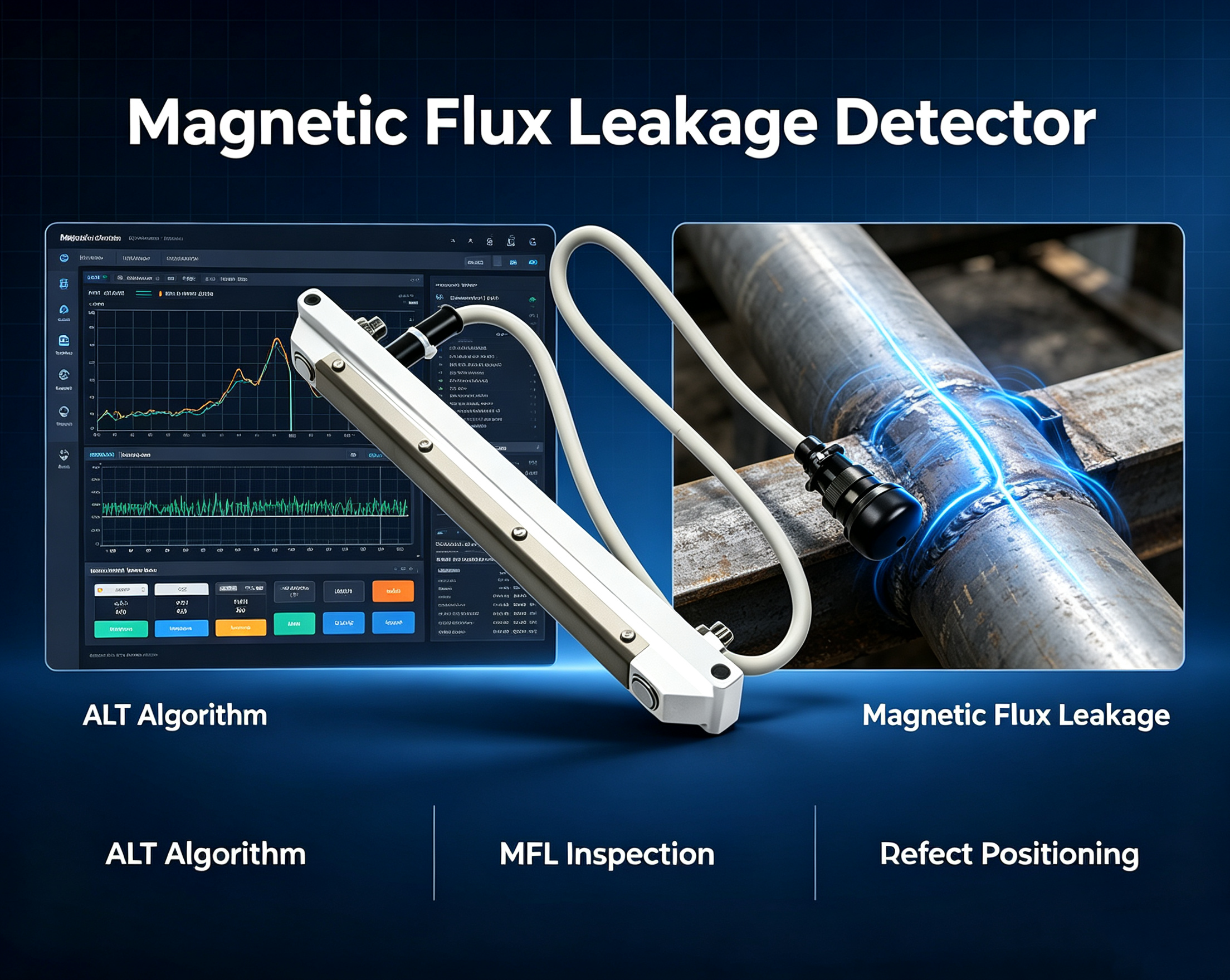
The core breakthrough of high sensitivity MFL probe technology lies in increasing the excitation frequency (from 6-7kHz to 10kHz-100kHz) to concentrate the magnetic field energy more on the near surface of the workpiece, thereby significantly improving the detection sensitivity of small defects on the surface and near surface.
Application Scenarios
Magnetic flux leakage detection is widely used in fields that require high safety and reliability:
Energy industry: seamless steel pipe crack inspection equipment, long-distance pipelines for oil and natural gas, refinery pipelines.
Power industry: boiler heat exchange tubes, nuclear power plant cooling circuit pipelines.
Municipal engineering: urban water supply and heating main network.
Precision manufacturing: automotive transmission shafts, aerospace hydraulic pipes, geological drilling drill rods.
🧲Technical advantage
Magnetic flux leakage (MFL) testing uses a magnetizer to locally magnetize steel pipes to saturation or near-saturation status. When the pipe wall is intact, magnetic field lines are confined inside the pipe. Once a defect exists, magnetic lines bend and escape from the pipe wall to form a magnetic leakage field. Hall sensors or induction coils inside the probe capture such leakage magnetic signals to identify the location and severity of defects.
💡Technical Advantages & Limitations
Core Advantages
- High efficiency & automation
Testing speed reaches 1.5–2.0 m/s, perfectly suited for full on-line inspection on production lines.
- Powerful environmental adaptability
It is insensitive to oil stains and rust on steel pipe surfaces, requiring no rigorous surface cleaning.
- Quantitative measurement capability
It can quantitatively calculate the depth, length and area of defects, providing data support for pipeline integrity management.
Main Limitations
- Material restriction
Only applicable to ferromagnetic steel pipes (carbon steel). It cannot work on non-ferromagnetic materials such as stainless steel and aluminum.
- Blind zone issue
A detection blind zone of around 20mm exists at both ends of steel pipes.
- Sensitivity to defect orientation
The technology performs best on defects perpendicular to the magnetization direction (e.g., transverse magnetization mainly detects circumferential defects). Its detection performance drops for defects parallel to magnetization, which usually requires multi-directional magnetization for full coverage.
- Difficulty in distinguishing inner & outer wall defects
For thick-walled steel pipes, it is hard to tell whether defects are on the inner or outer wall. Feature extraction algorithms or professional experience are required for identification.
R&D core led by senior industry professors, all technicians hold ASNT ISO 9712 certification
Supported by our 15 core patents and multiple independent software copyrights for MFL control & algorithm systems
All magnetic flux leakage detection core technologies are independently developed, realizing full import substitution of overseas brands such as Tuboscope and Foerster
Want to learn more about our upgraded MFL detection technology or get customized technical parameters? Contact our professional engineer team for free technical consultation and on-site testing solutions.
