compare MFL and ECT NDT technology. MFL leads in inspection speed, coating penetration & ferromagnetic tank/pipe corrosion testing. Learn best pick for steel corrosion inspection.
MFL vs Eddy Current (ECT): Core Comparison for Ferromagnetic Steel Pipe & Tank Floor Corrosion Inspection
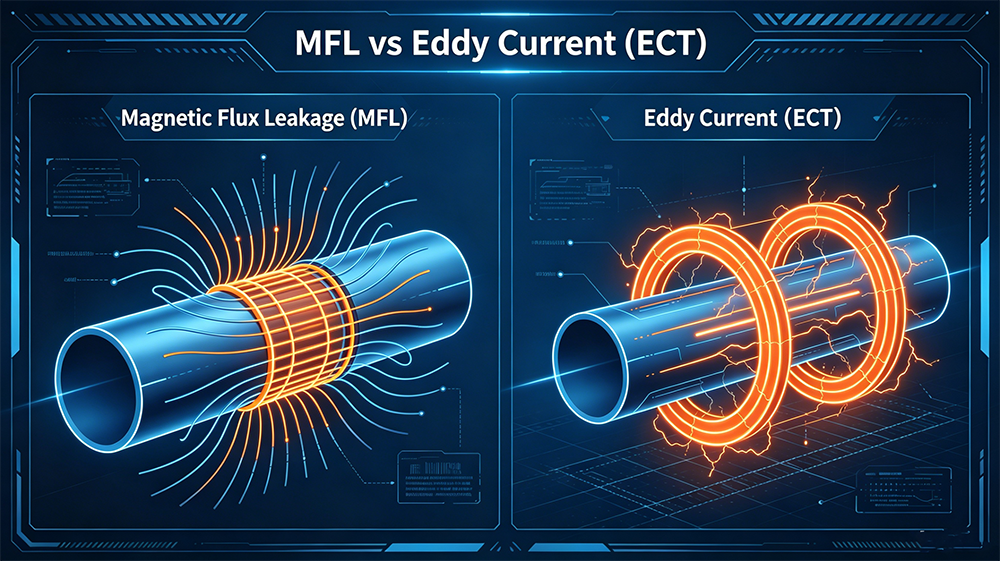
Non-destructive testing is essential for regular corrosion screening of oil & gas pipelines, storage tank bottom plates and ferritic steel facilities. Magnetic Flux Leakage (MFL) and Eddy Current Testing (ECT) are two widely adopted surface & subsurface flaw detection technologies in global NDT industry. While ECT has its unique application advantages for non-ferrous thin-wall components, MFL demonstrates overwhelming superior performance in inspection speed, coating penetration capability and corrosion detection on ferromagnetic carbon steel materials including tank bottoms and industrial steel pipelines.
This article elaborates the working principle differences, applicable materials, field performance and cost input of MFL and ECT, helping pipeline operators, tank maintenance companies and steel mill procurement teams select the most cost-effective inspection solution.
1. Basic Working Principle
Magnetic Flux Leakage (MFL)
MFL magnetizes ferromagnetic steel substrate to magnetic saturation via permanent magnet or electromagnetic assembly. Wall thinning, pits and corrosion defects interrupt internal magnetic flux; excess magnetic field leaks outside workpiece surface, captured by induction test probes to quantify corrosion depth and defect area. Core design targets thick ferrous steel inspection.
Eddy Current Testing (ECT)
Alternating high-frequency coil generates alternating electromagnetic field, inducing eddy current inside conductive workpiece. Defects change eddy current distribution to form feedback signal. ECT relies on skin effect; detecting depth is severely restricted by excitation frequency and workpiece permeability.
2. Core Comparison Table: MFL VS ECT (Focus on Speed, Coating Penetration, Ferrous Corrosion Inspection)
| Comparison Item |
Magnetic Flux Leakage (MFL) |
Eddy Current Testing (ECT) |
Advantage Side |
| Inspection Speed (Key Highlight) |
High-speed continuous scanning: 10–30 m/min for in-line steel pipe; 500–1200 ㎡/day for storage tank bottom automatic crawling inspection. Suitable for full-length batch production line inspection and large-area tank floor rapid screening. |
Low testing efficiency: Point-by-point segmented scanning, only 5–15 ㎡/day for tank plate; slow spot detection on pipeline, unable to match high-volume continuous online inspection requirement. |
MFL Overwhelming Advantage |
| Coating / Paint Layer Penetration Capacity (Core Highlight) |
Penetrates thick coating up to 3–12mm (epoxy paint, anti-corrosion asphalt coating, insulation layer). No need for complete coating stripping before inspection; partial local polishing is enough, drastically reducing pre-inspection surface treatment cost. |
Extremely limited penetration: Valid detection only under coating thinner than 0.2–0.5mm. Almost fails if paint/anti-corrosion layer exceeds 1mm; full coating removal mandatory before testing, high construction expense & long construction period. |
MFL Overwhelming Advantage |
| Applicable Base Material for Corrosion Detection |
Optimized for ferromagnetic carbon steel: Carbon steel pipeline, API OCTG tubing/casing, storage tank bottom plate, boiler ferrous sheet, all mainstream ferrous equipment in petrochemical & storage industry. Excellent signal response to wall loss, pitting corrosion, uniform thinning. |
Mainly for non-ferrous metal: Aluminum, copper, brass, thin stainless steel. Poor permeability matching with ferromagnetic steel; severe signal attenuation, low accuracy on thick carbon steel corrosion quantification. |
MFL Overwhelming Advantage |
| Maximum Effective Detection Depth |
Up to 30mm+ steel wall thickness, adapts thick-wall industrial pipeline & heavy tank floor plate corrosion inspection |
Only 0.1–3mm shallow surface layer, invalid for deep subsurface hidden corrosion inside thick steel plate |
MFL |
| Pre-inspection Surface Preparation |
Minor cleaning of loose rust, no full coating peel-off |
Complete paint & anti-corrosion coating stripping required |
MFL |
| Defect Focus |
Uniform wall thinning, pitting corrosion, subsurface internal corrosion, groove corrosion (tank bottom dominant flaws) |
Tiny surface crack, open surface defect; cannot measure corrosion wall loss depth accurately |
MFL |
| Environmental Adaptability |
Stable under dusty, slight oily, on-site outdoor field environment |
Sensitive to surface residue, paint leftover, metal dust; easy signal interference on rough industrial site |
MFL |
| Main Limitations |
Not applicable for non-ferromagnetic alloy (aluminum, austenitic stainless steel) |
Slow speed, strict surface pretreatment, poor thick-coating & deep corrosion detection |
ECT only |
3. Key Advantages Summary of MFL on Tank & Ferrous Pipe Corrosion Inspection
Remarkable Cost Saving on On-site Construction
Thanks to powerful coating penetration, MFL cancels full coating stripping work, saving massive labor & material cost compared with ECT, the biggest pain point of traditional eddy current corrosion inspection. For large oil depot tank bottom routine inspection, MFL cuts overall project cost by 40%~60% normally.
-
High Throughput Shortens Equipment Shutdown Period
High crawling & scanning speed helps asset owners finish full tank floor or whole pipeline inspection within shorter maintenance window, minimizing production halt loss for petrochemical and pipeline transmission enterprises.
-
Reliable Quantitative Corrosion Data for Ferromagnetic Facilities
MFL outputs accurate residual wall thickness & corrosion loss data, fully compliant with API, ASME tank & pipeline maintenance standards, supporting equipment residual life evaluation and maintenance decision-making, while ECT can barely realize quantitative corrosion depth reading on carbon steel.
4. Suitable Application Split: When to Use MFL / When to Choose ECT
Choose MFL in below scenarios:
- Routine corrosion inspection of crude oil/diesel storage tank bottom carbon steel plate
- Online/offline full-length corrosion & wall loss testing for seamless carbon steel pipeline, OCTG tubing
- On-site in-service inspection for buried ferrous pipeline with intact anti-corrosion coating
- Mass high-speed online NDT inspection on steel pipe production line
Choose ECT only in below scenarios:
- Surface tiny crack inspection of aluminum, copper, non-ferrous alloy tube
- Flaw detection of thin-wall non-magnetic stainless steel tube with bare surface (no coating)
- Precision inspection of thin non-ferrous finished parts in machining workshop
As a professional manufacturer of customized MFL test shoes and replacement MFL probes compatible with Tuboscope and mainstream global NDT systems, our factory supplies high-precision ferromagnetic corrosion inspection accessories for tank inspection companies and steel pipe mills worldwide. Our MFL test heads inherit core MFL technical advantages in fast scanning, strong coating penetration and stable corrosion signal output.
Contact us to get technical datasheet & customized quotation for your tank bottom / pipeline MFL inspection upgrade project.
