Full comparison between MFL and UT ultrasonic NDT. MFL boasts faster scanning, superior coating penetration for carbon steel tank bottom & pipeline corrosion. We supply interchangeable Tuboscope compatible custom MFL spare probes.
MFL vs Ultrasonic Testing (UT): Technical Comparison for Carbon Steel Pipeline & Storage Tank Bottom Corrosion Inspection
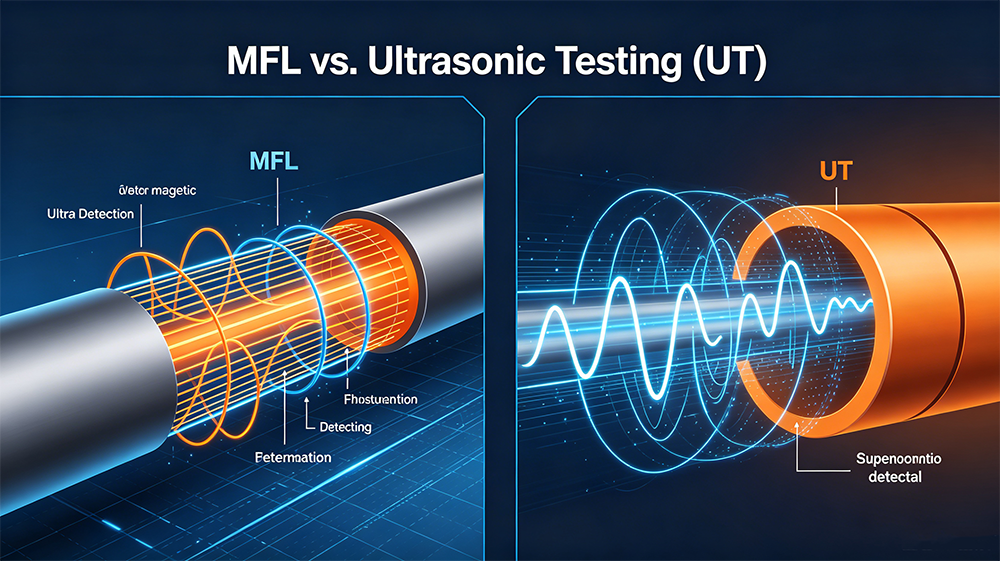
Ultrasonic Testing (UT) and
Magnetic Flux Leakage (MFL) are two mainstream quantitative NDT solutions widely used for ferrous steel corrosion assessment across oil & gas, petrochemical and steel manufacturing industries. While conventional UT delivers outstanding precision for single-point thickness measurement under ideal bare steel conditions, MFL technology shows overwhelming competitive edges in inspection running speed, anti-coating penetration performance and large-area corrosion screening on ferromagnetic carbon steel including storage tank floor plates and industrial seamless pipelines.
For asset owners, pipeline operators and steel mill NDT departments, choosing between MFL and UT directly affects inspection cycle length, on-site construction cost and equipment downtime loss. This guide breaks down core differences between two inspection technologies, alongside targeted procurement tips for aftermarket MFL test heads compatible with original NOV Tuboscope systems.
1. Core Working Principle Overview
Magnetic Flux Leakage (MFL)
Powerful permanent magnets saturate ferromagnetic steel substrate magnetically; wall thinning, pitting corrosion and subsurface flaws disrupt internal magnetic flux, causing magnetic field leakage outside workpiece. Induction pick-up shoes capture leaked flux to calculate corrosion depth, wall loss and defect distribution. Designed inherently for rapid large-area scanning on thick ferrous metal with intact anti-corrosion coating.
Ultrasonic Testing (UT)
High-frequency sound wave penetrates steel material; ultrasonic echo reflection calculates residual wall thickness by measuring sound travel time between front and back wall of steel plate. UT requires direct tight coupling contact between probe and bare clean steel surface, severely restricted by surface coating, uneven paint and rust layers.
2. Detailed Comparison Table: MFL VS UT (Focus on Speed, Coating Penetration, Ferrous Corrosion Testing)
| Comparison Item | Magnetic Flux Leakage (MFL) | Ultrasonic Testing (UT) | Dominant Side |
| Inspection Running Speed (Core Highlight) | Continuous high-speed crawling scanning: 8–30 m/min on production-line steel pipe; 600–1500 ㎡/day automatic robot inspection for tank bottom. Entire large tank floor finished within 1–3 working days, perfect for full-coverage batch screening. | Single-point spot measurement only: 8–15 ㎡/day manual point-by-point testing; large tank inspection needs weeks of continuous field work, impossible for full-length high-speed online pipe inspection. | MFL Overwhelming Advantage |
| Coating & Insulation Penetration Capacity (Core Highlight) | Penetrate intact anti-corrosion paint, epoxy & asphalt coating up to 3–12mm thick. No mandatory full coating stripping; minor local grinding is acceptable, cuts massive surface pretreatment expense. | Almost zero penetration over coating thicker than 0.3–0.8mm; full stripping of all paint/rust layer is mandatory before coupling agent application, huge labor & construction cost. | MFL Overwhelming Advantage |
| Ferromagnetic Material Adaptability(Tank/Pipe Corrosion) | Optimized for carbon steel, OCTG tubing/casing, tank bottom plate, boiler sheet; stable signal output for uniform thinning, pit corrosion, subsurface hidden wall loss, fully matches API maintenance inspection standard. | Works for bare clean carbon steel only; rough surface, residual coating or uneven corrosion leads to frequent echo loss & invalid reading, low efficiency for large-area tank corrosion mapping. | MFL Overwhelming
Advantage |
| Max Valid Detectable Wall Thickness | Up to 32mm thick carbon steel plate | Normally ≤20mm, signal weakens sharply on extra-thick tank floor | MFL |
| Pre-inspection Surface Preparation | Remove loose floating rust only | Complete coating removal + surface polishing + coupling liquid coating | MFL |
| Defect Inspection Logic | Whole-area continuous scan, generate full corrosion distribution mapping | Discrete spot check, easy to miss scattered small pit corrosion between test points | MFL |
| Main Drawbacks | Not applicable for non-ferrous metal like aluminum/austenitic stainless steel | Slow testing, strict surface pre-work, high field construction cost | UT |
3. Three Core Economic Advantages of MFL Over UT for Tank & Pipeline End Users
3.1 Dramatically Shorten Equipment Shutdown Period
Ultra-fast continuous scanning drastically shortens maintenance outage for oil depot storage tanks and in-service pipelines. Operators complete scheduled corrosion inspection within planned maintenance window and avoid extra production loss caused by prolonged UT spot-testing cycles.
3.2 Cut On-site Surface Treatment Cost Greatly
Thanks to excellent coating penetration capability, MFL eliminates expensive full paint stripping required by UT, saving 45%~65% total field inspection engineering cost for large-scale tank maintenance projects.
3.3 More Comprehensive Corrosion Data Report
Continuous full-surface scanning avoids random missing of scattered pitting corrosion that commonly occurs with discrete UT point measurement, helping asset managers make accurate maintenance & replacement decisions per API specifications.
4. Application Split: Select MFL or UT Based on Your Actual Inspection Demand
Pick MFL If Your Project Is:
- Full floor corrosion inspection for crude/diesel storage carbon steel tank bottom
- Online high-speed wall loss testing on seamless carbon steel & OCTG pipe production line
- In-service buried pipeline inspection with original intact anti-corrosion coating
- Large-area batch corrosion screening for petrochemical plant ferrous equipment
Pick UT Only For:
- Precise single-point thickness verification after abnormal MFL alarm
- Small bare steel component lab precision thickness calibration
- Non-ferrous alloy wall thickness measurement
5. Conversion Section | Our Core Service: Interchangeable Tuboscope MFL Spare Parts & Custom Test Head Solution
As a professional aftermarket MFL component manufacturer specializing in NOV Tuboscope compatible replacement test shoes & MFL probe assemblies, we focus on three core service directions to help global NDT operators upgrade their existing Tuboscope MFL system and reduce long-term operational cost:
5.1 Interchangeability | 1:1 OEM Flat Replacement for Original Tuboscope Parts
All our longitudinal/circumferential MFL test heads follow original Tuboscope drawing, wiring definition and signal output standard, realizing 100% plug-and-play interchangeability. Direct swap worn original Tuboscope shoe without equipment modification, system recalibration or program adjustment, effectively replace expensive OEM original spare parts as cost-effective technical alternative. This core interchange design becomes the top choice for global steel mills and tank inspection companies to cut Tuboscope original procurement expenditure.
5.2 Wear Life Optimization | Upgraded Wear-resistant Structure Extend Service Cycle
We optimize contact surface alloy formula and internal magnetic circuit structure for aftermarket MFL shoes compared with standard original Tuboscope consumables. Our upgraded wear-proof casing doubles average service life under high-speed continuous pipe feeding condition, reducing frequent spare part replacement downtime and recurring consumable purchasing cost for production line end users.
5.3 Customization Agility | Fast Lead-time Custom Solution for Non-standard Tuboscope Equipment
We own independent machining & R&D workshop to support fast customization for obsolete, modified or non-standard Tuboscope retrofit systems. Flexible adjustment on overall dimension, cable length, aviation plug pin definition and shell structure, with shortened custom production lead time vs global OEM suppliers. Quick customization response solves the industry pain point: discontinued old Tuboscope models cannot source original factory spare parts.
Request Tuboscope MFL Datasheet | Get Custom Replacement Quotation
For large-area ferromagnetic tank bottom and pipeline routine corrosion inspection, MFL is undoubtedly the cost-benefit winner versus traditional UT ultrasonic testing. If your facility equips NOV Tuboscope MFL inspection lines and you seek affordable interchangeable spare probes with longer service life and flexible custom support, our factory is your reliable long-term aftermarket MFL component supplier.
Professional MFL NDT Equipment Manufacturer | Import Substitution Solution for Seamless Steel Pipe Inspection
